- Readers
- Avg. rating
- 4.0
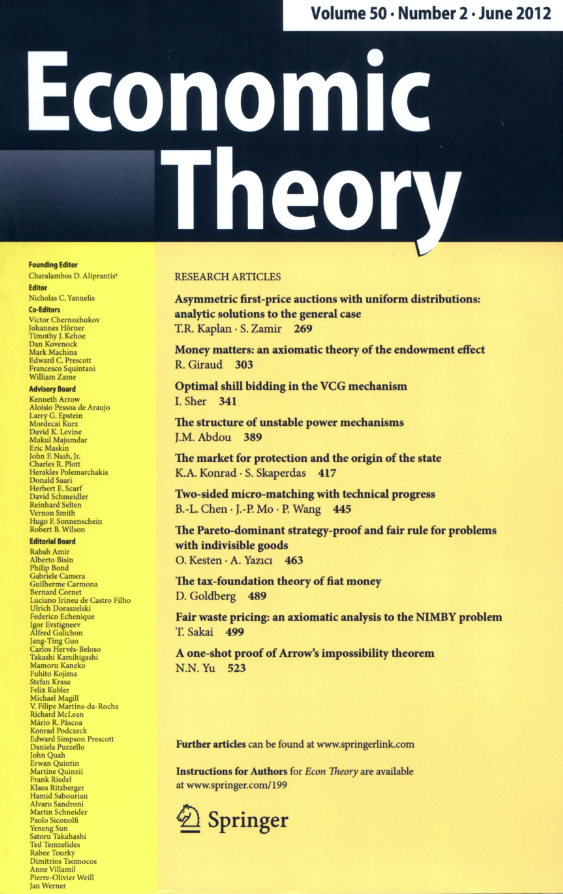
A one-shot proof of Arrow’s impossibility theorem2012
This is a short and concise proof of Arrow's theorem. It does this by identifying a pivotal voter who can alter social preference and then show they are a dictator. The statement of the theorem is the usual, it cannot be that there exists a SWF that satisfies Unanimity, AIIA, and Non-Dictatorship.
The proof is as follows. Suppose that \(R\) is a SWF that satisfies \(A_1\) and \(A_2\). Let \(\vec{\succsim}\) be fixed but arbitrary for which \(\forall \: n \in \mathbb{N} \Rightarrow a_i \succsim_n a_j\). This means every single voter prefers \(a_i\) to \(a_j\). Because of property \(A_1\) this means \(a_1 \triangleright a_j\). Then imagine a flipping process where all voters switch from \(a_i \succsim_n a_j\) to \(a_j \succsim_n a_i\) so again by \(A_1\) we have that \(a_j \triangleright a_i\). Because of this flip it has to be that the machine switches \(\triangleright\) after somebody's switch. We call this person \(n_{ij}\) the (\(i, j\))-pivotal voter. Because of \(A_2\) no other \(a_k\) alternative matters for this switch.
\[ \begin{array}{c|cccccc} & 1 & \cdots & n_{ij}-1 & n_{ij} & n_{ij}+1 & \cdots & N \\ \hline & a_j & \cdots & a_j & a_i & a_i & \cdots & a_i \\ \vec{\succsim}^{\prime} & a_k & \cdots & a_k & & & & \\ & a_i & \cdots & a_i & a_j & a_j & \cdots & a_j \\ & & & & a_k & a_k & \cdots & a_k \\ \hline & \square & \cdots & \square & & & & \\ & \square a_j & \cdots & \square a_j & a_j & a_i & \cdots & a_i \\ \vec{\succsim}^{\prime \prime} & \square & \cdots & \square & & \square & \cdots & \square \\ & a_i & \cdots & a_i & a_i & \square a_j & \cdots & \square a_j \\ & & & & a_k & \square & \cdots & \square \end{array} \] Now look at the scenario above. We first have \(\vec{\succsim}^{\prime}\) and three alternatives \(a_i, a_j, a_k\). We are at the point before the pivotal voter's flip. This person's rankings are currently \(a_i \vec{\succsim}^{\prime}_{n_{ij}} a_j \vec{\succsim}^{\prime}_{n_{ij}} a_k\). Because they are the pivotal voter we have that 50.1% of voters prefer \(a_i\) to \(a_j \Rightarrow a_i \triangleright a_j\). If you look at the table you will notice every single persona agrees \(a_j \succsim a_k\) so the voting machine outputs \(a_j \triangleright a_k\). Thus we have \(a_i \triangleright a_j \triangleright a_k\), which matches the pivotal voter's preference. Now imagine \(\vec{\succsim}^{\prime \prime}\) and we can represent possible \(a_k\) rankings by \(\square\). If you look at the table, every single voter that is not \(n_{ij}\) can rank \(a_k\) wherever they please in a way that does not change how they rank \(a_i\) and \(a_k\). The pivotal voter ha snow flipped and now ranks \(a_j \vec{\succsim}^{\prime \prime \prime}_{n_{ij}} a_i \vec{\succsim}^{\prime \prime}_{n_{ij}} a_k\). Since they are the point of the flip the machine now also flips to \(a_j \trianglerighteq a_i\). Remember, nobody has changed how they compare \(a_i\) and \(a_k\). Because of property \(A_2\) this means that we still carry \(a_i \trianglerighteq a_k\) from \({\succsim}^{\prime} \Rightarrow\) \[\forall \: i \neq j \neq k \Rightarrow a_j \succsim_{n_{ij}} a_k \Longrightarrow a_j \trianglerighteq a_k\] If we look at the squares we don´t know anything on how people rank \(a_j\) and \(a_k\). It could be that everybody has \(a_k \succsim a_j\). But we have \(a_j \triangleright a_k\) because of ONE person. This violates \(A_3\).
The paper is very good, althought maybe it could use with clearer language at times.
Comments
Sign in to comment.